In my free time I enjoy developing game concepts for paper and pencil RPGs. This is where I post things I create, or ideas I want to share.
Milton, NM
The Netflix show Stranger Things was pretty inspirational, so I went and created this fictitious small town called Milton New Mexico as a setting for a similar style game. To create the town I used a modified version of the Microscope collaborative setting rules, and all the players were able to contribute ideas to the town's history and various mysteries. I then designed a map to tie everything together and give a common sense of geography. (For the actual game the players all rolled up 9th graders in 1986. I used the Bubblegumshoe RPG rules set.)
The campaign is on haitus but the players have enjoyed putting the clues together about the "strange doings down by the Circle K", and are keen to come back to it in a few months.
TRANSCAUTO - Trans-Caucasian Theater of Operations Map
So the classic cold war military game Twilight:2000 by GDW gave the tools to referees to run a very deep sandbox type game in central Poland as the world slides into anarchy. (I did a pretty involved fan project around that specific sandbox already.)
But thinking about it more, I got interested in exploring other locations in this fictitious war... especially after looking at the RDF Sourcebook about the situation in Iran happening concurrently to the game's main sandbox in Europe. In particular, I got interested in the Trans-Caucasian region, which is the mountainous area between the Black Sea and the Caspian Sea. This is a very ancient and diverse mountainous region, which also would have been a key front in WWIII... a bottleneck that holds a major oil pipeline and also non-Russians under the soviet rule for over 60 years.

Close up of map
So I designed a map of the region using cold war era CIA maps for reference and made it in the style of the other GDW campaign maps. It was a fun bit of cartographic fun for me and could be used by a referee looking to run a campaign in Asia Minor with a whole different set of issues to confront his or her players.
The map is available as a high quality print-on-demand poster via Zazzle, and as a digital download or more affordable mini-poster via RPG Now.

Please note: In real-world history, the withdrawal of the Soviets led to a number of ethnic clashes with a significant loss of life to the region. My intent is not to make light of those events, nor am I expressing an opinion this history. I have just sought to learn more about a part of the world I previously knew little about, and make a fun game aid in the process.
threading the needle
The Star Trek Universe circa 2166.
All of the recent Sci-Fi in movies and on TV inspired me to put together a Star Trek game. I decided to set it right after the end of Enterprise, or about 100 years before time of Kirk and Spock, when the Federation was just exploring beyond the local star systems. (this also puts it safely before the JJ Abrams timeline divergence. It is still not clear if the new series coming early next year will take place in the new timeline, or in Star Trek Classic.) This map is one I put together based on various sources, with plenty of blank space on the left, for the players to explore.
The hardest part is balancing an old school vibe with keeping things also canonical. I am a huge fan of the 1980s-2000s Star Trek series, that created a deep universe and political drama. But the classic series's pulpy vibe with its gunboat diplomacy, green-skinned dancing girls, and bizarre 60's psychedelic weirdness is pretty awesome too. So the map serves as the framework- where the numbered sectors contain the "serious" Star Trek universe, and there are trade agreements to solve and an evolving political arc. Meanwhile the unexplored zones indicated with a "Z" is the pulp-y space opera parts of the universe. I am treating the whole thing like a big sandbox for the players to have fun in, and they can choose which parts they are interested in exploring.
Each hex is 1 parsec, and may have one or more uninhabited M class star systems that are not shown. Only star systems that would be known at that time and are of K class or larger, are in habited, or are notable in some way are shown. I laid it out to printout on a 11x17 tabloid page, extending toward the frontier where the players will be spending their time. I may go back and make a larger 'square' version that extends evenly around the federation in all directions.
Here is a PDF version of the map that is better for printing. Feel free to use however you wish.
Cobalt Springs, Oregon

Checking out the groovy Adventure Time meets Rick and Morty style RPG Far Away Land RPG, I had the idea of a Gravity Falls kind of scenario that gave a way to kick off a campaign from Earth. So of course I threw a simple PNW town, and a very open ended scenario idea. It can be printed out double sided to be two pages- one for the players describing the town, and one for the referee with what is really going on. But the town write up is generic enough that it can be used as a setting on just about any game. (but you really should pick up a copy of the Far Away Land RPG…)
Cobalt Springs, Oregon (PDF)

An Old School Polish Sandbox
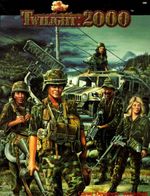
While I played first edition D&D back in the day, I was a SF fan and so pretty quickly moved on to Traveller, 2300AD, and other GDW games. In college I played in a friends Twilight: 2000, but it was in a gonzo modern campaign, and had nothing to do with the original game setting. So it wasn’t until fairly recently that I picked up T2K 1st ed. and its core modules to read for the first time. And I was surprised to discover that it is a classic sandbox game- but hampered by poor organization.
The original rules for Twilight: 2000 give an initial adventure called Escape from Kalisz, where it sets up the PCs are solders in WWIII cut off behind enemy lines. They have escaped a disastrous battle in the middle of Poland, and are on their own. Furthermore the game has established that all of Europe has been devastated by the war, so there is no law and order for hundreds of kilometers in any direction. They have limited information about their surroundings, and there are Soviet soldiers and marauders in all directions. It is a 'points of light' setting where the PCs are free to continue to fight for democrocy, or set themselves up as warlords themselves. The intro module does not have plot- just descriptions of the various villages and towns of central Poland in the vicinity of their starting point, and what kind of help or threats can be found there.
The PCs are not given an objective- they have some information about what is in their area- but there is no place they being directed to try to make it to, other than some rumors that Krakow is supposed to be safe. They are on their own to decide which direction to go, and how best to survive. But the first 5 modules published continued and completed the default campaign:
- Free City of Krakow – a freeform module that details Krakow and expands the sandbox south to the Czechoslovakian border.
- Pirates of the Vistula – a structured module that has the Party travelling to the northeast on the Vistula River to Warsaw. Details the towns along the river.
- The Ruins of Warsaw – a freeform module that details Warsaw and expands the sandbox to the east.
- The Black Madonna – a freeform module set in Silesia. Expands the sandbox to the South West, to the Czech/German Border
- Going Home – A structure module (although not as structured as the Pirates of the Vistula) that has the PCs trying to make it to a port in Germany to catch the last transport ship home to the USA. Expands the sandbox to the west, through Germany all the way to the French DMZ.
- Also issue 25 of Challenge magazine had an article titled The Baltic Coast: A Looter's Guide, which expanded the sandbox to the north, along the Baltic coastline.
(After Going Home, GDW began producing adventures set in North America, and gradually switched to more structure modules- which were more the preferred style by the late 1980s. Later modules returned to Europe and Poland, but did not return to the sandbox format.)
…So split between these publications, quite a bit of Poland was detailed with adventure hooks and threats. If the party chose to strike out into a random direction, the GM has plenty of information about what they would encounter.
The biggest stumbling blocks to this is that all this information is split up between multiple books, as well as the locations were not keyed except by the town name. So looking up polish location names in a map, and then hunting thought various books to see if that location has an entry was probably too unwieldy for most GMs.
My solution: I went through the laboured process of collating the sandbox information from the publications, and keying it to a hex grid overlaying the maps. Theoretically this would help a GM run a sandbox game set in Poland, since it would be much faster to look up a hex number to see if it has a description. I also made a more detailed handout for the players explaining the events leading up to the Escape for Kalisz adventure.
The Index:
- Eastern European Hexmap index - A compiled list of the sandbox content, keyed to the hexmap's hex numbers.
- Eastern European Hexmaps - The maps of Poland and German, with a numbered hex grid superimposed.
The player resources for Escape from Kalisz:
- Escape from Kalisz: The Death of a Division (Player Background for the start of the campaign)
- Final Intelligence Report player handout (re-laidout for clearer printing.)
These are provided solely as aids for GMs to improve their Twilight:2000 gaming.
Here are a couple of topo maps I think would be cool to have printed out and hand to Players. (note these are very large map files)
- Southern Poland Including Kalisz, Krakow, & Silesia
- Northern Poland including western USSR
- Germany & Denmark