In my free time I enjoy developing game concepts for paper and pencil RPGs. This is where I post things I create, or ideas I want to share.
Staying Alive on I-75
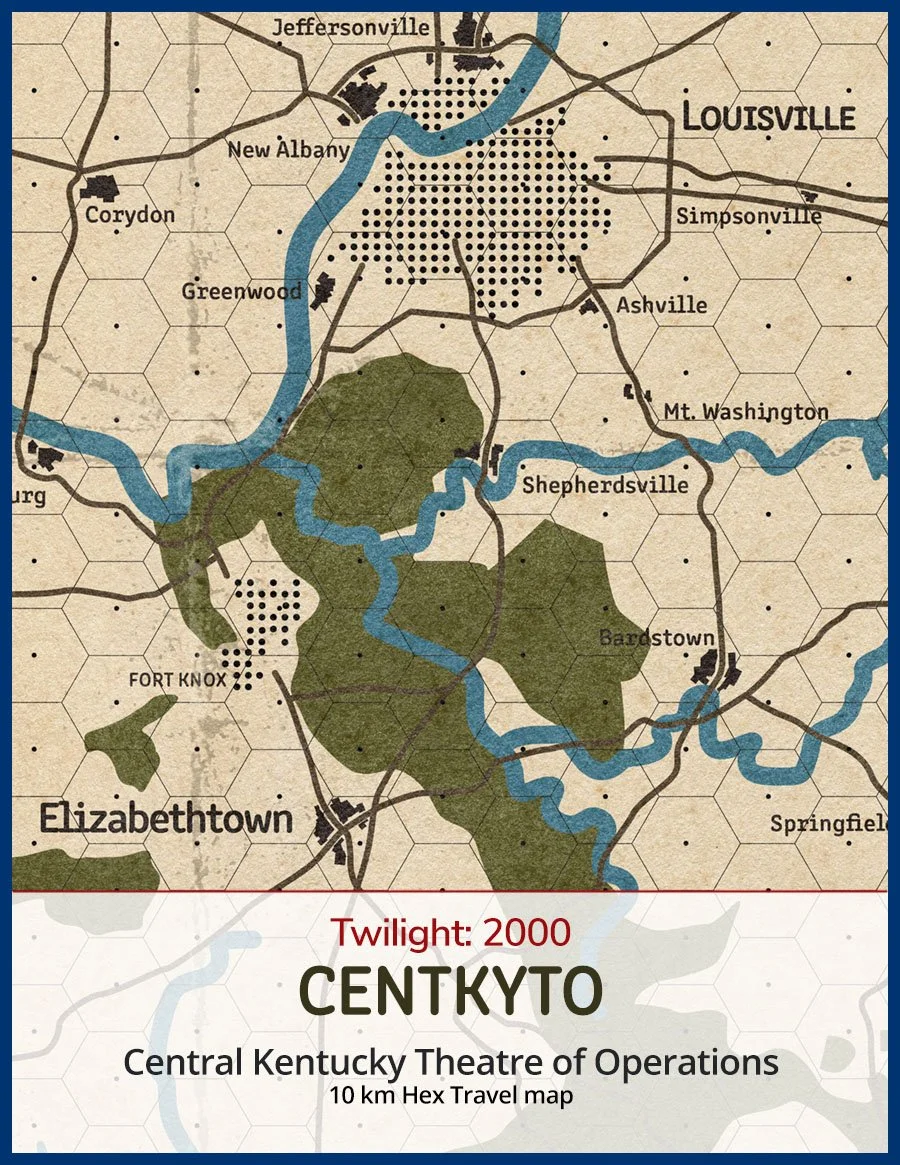
Quick plug here, back over the summer I tried out making a Travel Map for Free League’s upcoming 4th Edition of Twilight: 2000 and publishing it via the Free League Workshop in DrivethruRPG.
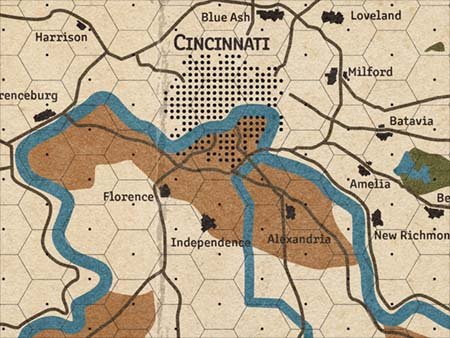
CENTKYTO is in the same style as the Poland and Swedish travel maps that come with the game, but it is focused on Central Kentucky in the U.S.A. I chose that location because it’s where I grew up, and most post-apocalyptic games revolve around the players playing in the ruins of their hometown.
Also while I don’t know if Free League will be publishing anything set in the states, I figured that this was probably an area that they were not thinking of doing anything for, so it was fair game.
I don’t have a gazetteer or anything to go with it, it is just a map. I figure it can work just as well for a WWIII campaign as it would for a Walking Dead-style zombie apocalypse campaign or a Battle: Los Angles-style alien invasion campaign.
I did include assets and instructions for using the map on Roll20 and Foundry VTTs, which is why it is a bit more expensive than some of the other Workshop maps out there.
CENTKYTO T2k Travelmap on DrivethruRPG
T2K 4e Lifepath Booklet
Stalker on a Halt by Bobrbor
So this month the 4th edition of Twilight:2000 is being released by Free League, and it does a lot of things very well. The new encounter system is interesting, and definitely solves the problem of the game grinding to a halt whenever the party entered a new hex. (My earlier attempt to solve this problem was to reorganize the 2.0 version of the encounter system to be easier on the referee to use to try and speed things up. Free Leagues totally revamped it and is using a card-based system that is definitely faster, but less flexible in my opinion.)

I do like how they do the life path method for character creation especially, but for some reason, the way it is described in the book was hard for me to follow. So as part of my usual M.O., I rewrote the process in my own words mostly to try and understand the flow, and organize the information in a way that made more sense to me.
Ideally, this document gives a player everything they need to complete the lifepath flow. But it doesn’t try to explain game rules or any unnecessary concepts. (Since that is what the rule book is for.)
I went ahead and made it a printable booklet so that the referee can print out multiple copies on a black and white printer and give to players at the table to do their character creation without everyone fighting over the book.

Since it is formatted as half-letter pages, ideally you can print it booklet style. On the print dialog (as shown to the left) there is a button for Booklet mode that will print the pages onto a double-sided landscape letter page that is organized so that you just staple it down the middle and fold it.
Having a Long-Arm stapler of course makes the stapling a lot easier.
Alien RPG Locations
Here is my attempt to sort out the main regions in the Alien universe as detailed in Free League’s RPG. I felt like there was a need for a big picture political map, that didn’t get crowded with the names of systems or sectors.
Map of key regions mentioned so far and where they are located. (or my best guess)
And here is a zoomed out view, showing roughly some of the more distant locations, or at least the direction they lie.
…and here is a historical view of the map over time. (not canonical… its just my best guess.)
And here is a Wallpaper [1080x1920] just because…
T2K Encounters Reorganized
The rules for Twilight:2000 version 2.x were always a bit crunchier than I liked my games to flow, but one aspect I thought was quite innovative. The encounter system was more complex than most games, in that while each area on the map had a physical terrain type (Forest, Hills, Swamp, etc) like most games, it also could have a Territory type as well. This described the tactical or social situation in that area, (for example: Organized, Contested, Anarchy, Devastated, etc). Then there were encounter tables based on the combination of those two data points.
The really interesting part for as a referee was that the players would be able to predict only part of what to expect by looking at the map, but the nature of the territory would only become apparent by talking to NPCs, scouting the region, or simply inferring by the type of encounters they were having. Plus as the referee, I could manage a strategic level story, where on my private version of the map I track the various faction’s turf or movements as colored-in clusters of hexes. Plus, if the players understand that there is a real pattern (and not just pure randomness) they will see the value in planning their movements in a more realistic fashion.
Unfortunately, like many of GDW’s products, a good idea was presented in (for me) a profoundly confusing fashion. (Which I attribute to a hard page limit, requiring quite a bit of linguistic shoehorning) So I took a stab at reorganizing the encounter system from the 2.2 rules into a booklet that hopefully is something that a referee can consult at the table and generate encounters in a much faster fashion.
(This is very much a work in progress, so please feel free to leave comments below. I will probably make revisions and repost it here.)
T2K Encounters Booklet (Draft Version)
Hyperborea

I have been digging deep into the works of Clark Ashton Smith recently, especially his Hyperborean Cycle stories that have strong connections to the mythos of Lovecraft. They are darkly humorous stories of baroque lands and flawed heroes getting their comeuppance.
While Lovecraft came up with names for locations that emphasized their alien and weird natures, Smith was a poet by nature and so he found names for his doomed cities that had a lyrical style to them.
Anyway, the 1971 Ballantine collection has a rather nice map of this lost land that seemed worth scanning and cleaning up a bit, to have on hand when reading the stories.
