In my free time I enjoy developing game concepts for paper and pencil RPGs. This is where I post things I create, or ideas I want to share.
Milton, NM
The Netflix show Stranger Things was pretty inspirational, so I went and created this fictitious small town called Milton New Mexico as a setting for a similar style game. To create the town I used a modified version of the Microscope collaborative setting rules, and all the players were able to contribute ideas to the town's history and various mysteries. I then designed a map to tie everything together and give a common sense of geography. (For the actual game the players all rolled up 9th graders in 1986. I used the Bubblegumshoe RPG rules set.)
The campaign is on haitus but the players have enjoyed putting the clues together about the "strange doings down by the Circle K", and are keen to come back to it in a few months.
An Old School Polish Sandbox
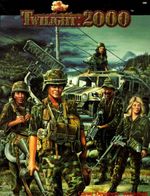
While I played first edition D&D back in the day, I was a SF fan and so pretty quickly moved on to Traveller, 2300AD, and other GDW games. In college I played in a friends Twilight: 2000, but it was in a gonzo modern campaign, and had nothing to do with the original game setting. So it wasn’t until fairly recently that I picked up T2K 1st ed. and its core modules to read for the first time. And I was surprised to discover that it is a classic sandbox game- but hampered by poor organization.
The original rules for Twilight: 2000 give an initial adventure called Escape from Kalisz, where it sets up the PCs are solders in WWIII cut off behind enemy lines. They have escaped a disastrous battle in the middle of Poland, and are on their own. Furthermore the game has established that all of Europe has been devastated by the war, so there is no law and order for hundreds of kilometers in any direction. They have limited information about their surroundings, and there are Soviet soldiers and marauders in all directions. It is a 'points of light' setting where the PCs are free to continue to fight for democrocy, or set themselves up as warlords themselves. The intro module does not have plot- just descriptions of the various villages and towns of central Poland in the vicinity of their starting point, and what kind of help or threats can be found there.
The PCs are not given an objective- they have some information about what is in their area- but there is no place they being directed to try to make it to, other than some rumors that Krakow is supposed to be safe. They are on their own to decide which direction to go, and how best to survive. But the first 5 modules published continued and completed the default campaign:
- Free City of Krakow – a freeform module that details Krakow and expands the sandbox south to the Czechoslovakian border.
- Pirates of the Vistula – a structured module that has the Party travelling to the northeast on the Vistula River to Warsaw. Details the towns along the river.
- The Ruins of Warsaw – a freeform module that details Warsaw and expands the sandbox to the east.
- The Black Madonna – a freeform module set in Silesia. Expands the sandbox to the South West, to the Czech/German Border
- Going Home – A structure module (although not as structured as the Pirates of the Vistula) that has the PCs trying to make it to a port in Germany to catch the last transport ship home to the USA. Expands the sandbox to the west, through Germany all the way to the French DMZ.
- Also issue 25 of Challenge magazine had an article titled The Baltic Coast: A Looter's Guide, which expanded the sandbox to the north, along the Baltic coastline.
(After Going Home, GDW began producing adventures set in North America, and gradually switched to more structure modules- which were more the preferred style by the late 1980s. Later modules returned to Europe and Poland, but did not return to the sandbox format.)
…So split between these publications, quite a bit of Poland was detailed with adventure hooks and threats. If the party chose to strike out into a random direction, the GM has plenty of information about what they would encounter.
The biggest stumbling blocks to this is that all this information is split up between multiple books, as well as the locations were not keyed except by the town name. So looking up polish location names in a map, and then hunting thought various books to see if that location has an entry was probably too unwieldy for most GMs.
My solution: I went through the laboured process of collating the sandbox information from the publications, and keying it to a hex grid overlaying the maps. Theoretically this would help a GM run a sandbox game set in Poland, since it would be much faster to look up a hex number to see if it has a description. I also made a more detailed handout for the players explaining the events leading up to the Escape for Kalisz adventure.
The Index:
- Eastern European Hexmap index - A compiled list of the sandbox content, keyed to the hexmap's hex numbers.
- Eastern European Hexmaps - The maps of Poland and German, with a numbered hex grid superimposed.
The player resources for Escape from Kalisz:
- Escape from Kalisz: The Death of a Division (Player Background for the start of the campaign)
- Final Intelligence Report player handout (re-laidout for clearer printing.)
These are provided solely as aids for GMs to improve their Twilight:2000 gaming.
Here are a couple of topo maps I think would be cool to have printed out and hand to Players. (note these are very large map files)
- Southern Poland Including Kalisz, Krakow, & Silesia
- Northern Poland including western USSR
- Germany & Denmark
Traveller and Sandboxing
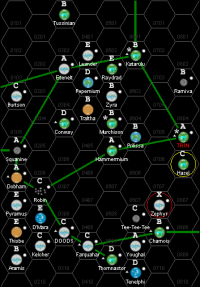
I have been thinking about SF Sanboxes of late, since with the new year, Farscape has shown up on Netflix streaming.
Anyway the odd thing about sandbox games, is that you need a region of unexplored territory near a town or a home base. The tricky part is the question of why hasn't anyone in the town gone and fully explored the region already.
The answer is usually either a barrier has recently gone away, or the home base was recently moved. In fantasy, the barrier is frequently some sort literal magical barrier, or line that no one was able to cross. but then around the time the heroes arrive, the barrier inexplicably weakens, and they are the first ones to explore what is on the far side. They are able to go and fight monsters and gain treasure, but return to the safety of the town at regular intervals. It occurred to me that this is what ST:Deep Space 9 perfectly encapsulate- a well established town that suddenly has a door to an unknown region appear on its doorstep.
But an even more common case is where the whole town is shifted into terra incognito, and the heroes are exploring their environment. This is the shipwrecked genre, and the 'town' are the people the heroes are protecting. Shows like Lost, Farscape, BSG, or ST: Voyager are more in this vein, where the heroes have to protect a group after then have been cast into a dangerous environment.
Now I dig the great sector maps of traveller as much as anyone- especially the ones Judges Guild put out. But I am now thinking about how a sandbox SF game could work. Here is what I am thinking:
- The GM rolls up a bunch of systems using the Traveller system generation rules, on some 5x8 index cards. for inhabited worlds, he gives it a little flavor text, but leaves most of the back of the card clear. Each card should have an Index Number.
- He gets a sheet of Hex Gaming Paper, and marks a hex near the middle of the paper as the starting point.
- For the new campaign, he has players roll up characters for the SF game they are using (Traveller, Stars w/out Number, 2300AD, Star Frontiers, etc) and provides them with a sector map, such as the Spinward Marches, and points to one of their stars as their current location.
- Somehow (either following up on a legend, or a quest given to them) they go to explore a nearby region of space that is reported to have strange properties, and is a sort of Bermuda Triangle for ships. There they find a Stable Wormhole, that via Deus Ex Machina they are pulled through.
- Now they get the big blank sheet of gaming hex paper, and find they are surrounded by unfamiliar stars, and can choose their direction to explore. Its too dangerous to jump blind into an uncharted hex, so no matter their ship's normal jump rating, can only explore at Jump-1, but when going back to already explored hexes, they can move at their normal Jump rating.
- Every time they enter a new Hex, the DM rolls on a chart* and if it comes up that there is a system in any of the neighboring unexplored hexes, and he draws a card from his deck for any that have systems. He then marks on the Gaming paper with that card's index number. The party can then choose to land on that planet have have an adventure there for the week, or keep on exploring. They can mark their path on the map, to keep track of their explorations, or at least mark empty hexes somehow to show they have already been visited.
Over time, they should have a pretty detailed map of this new area of space. The DM can decide whether they have the option to pass back through the wormhole anytime they need supplies, or sell their accumulated loot- or if they are stuck here (like John Crichton ) and their story arc involves finding a way to open the wormhole in the other direction.
*A chart for what is in a hex still needs to be created. It could be a simple as a D12 (or a D20 if you want a less dense region of space) with a 1 chance on there being a system in any given hex, or it could be a more detailed percentage where other random space phenomena could be encountered.
The party should be required to manage supplies- i.e. each jump is a set amount of time, and their ship can only jump so many times before they run low on food, air, and fuel.
Now the limit of information the party has, is another issue. In a wilderness sandbox, you can only see as far as you have line of sight, so you really only can see into the next 5 mile hex at any time. But in space, you theoretically can see everything, so filling in the map one hex at a time seems odd. Here are my initial thoughts on how to address this:
You are in a totally new space, so you don't have millennia of stellar observation to refer to. A small near star, and a big distant star look pretty much the same. And if you take the time to try and map all the visible stars looking for the nearest ones, you will run out of air long before you have anything useful.
or you happen to be in a nebula or cluster, and the sensors are too confused to make accurate readings.
Star maps in this region should be super rare and highly guarded, or most of the worlds are pre-spacefaring. Allowing them to go to the local Astrogator's guild and fill in big chunks of the map seems like it would kill the fun in the game. (but if the party is getting frustrated with the pace of exploration you let them find a fragment of the map as a reward. (They find an ancient derelict ship, and its astronavigation computer holds the data for a region of space... of course it may be on the far side of the map from the party, and be centuries out of date...)
If the DM is interested in having bigger arcs to his campaign, then Random Planet of the week, he could in secret come up with the bigger interplanetary forces at play in this region of space, and sketch out on a separate hex map the rough areas they are active. then when the Players reach one of those areas, any system cards drawn there should have a bit of that larger story added to them. (i.e. the card might be for the planet of happy woodchuck people, but the DM drew it in a hex that falls in a region that is home to the evil overlord, then he can update the flavor on the back of the cart to the effect that the woodchuck people are being cruely oppressed by the overlord's forces.) The idea is that some interesting scenarios should emerge.
Also if the PCs are able to travel back through the wormhole reliably (Perhaps once they have found the wormhole regulator maguffin) then a different region of play happens, as they decide what to do with this knowledge. Is the evil overlord on the other side also able to come through the wormhole to invade the Spinward Marches? Can the PCs rally the planetary governments in time? As the holders of the only map of the other side, can they use that for wealth and power, or will they be hunted by all those that want to know the secret of the wormhole?